8.29.2010

NEWS: Underoath lineup changes, Peter Wichers gets more production credits.

Aaron Gillespie announced earlier this year that he was leaving Underoath, which leaves the band with no original members. With Gillespie's unique sound absent, both on drums and his half of the band's dueling vocals, it will be interesting to see what their next album turns out to be. Daniel Davison, formerly of Norma Jean, has signed on for the upcoming Underoath album and tour, but hasn't been confirmed as an official replacement. Davison contributed drums to the track "Desperate Times, Desperate Measures", on Underoath's 2008 album Lost in the Sound of Separation, the band's darkest offering to date. Jeremy Griffith, who brought us Norma Jean's latest album, Meridional, is signed on to produce. You can't see it, but I look very excited.

-----------------------------------------------------------------------------------------------

In keeping with their Swedish melodeath influenced sound, Washington D.C. giants Darkest Hour have tapped prodigal Soilwork guitarist Peter Wichers to produce their upcoming album, set for an early 2011 release. Previous albums have been produced by the likes of fellow Swede Fredrick Nordstrom and Canadian metal auteur Devin Townsend


8.03.2010

WEEKLY TIDBITS: It's 100 degrees out, but there's free Baths and Soilwork.

I won't stop talking about Baths. Deal with it, there are free sounds in it for you. Last week Mr. Wiesenfeld recorded a Sprout Session for Dublab. It's available for free through itunes and you can check it out here. Baths returns to Austin soon, opening for El Ten Eleven, another artist well worth admission. It's all going down September 6th at the Mohawk.

On the angrier side of things, Swedish melodic-metal veterans Soilwork will be at Emo's Thursday night, in support of The Panic Broadcast, their 8th album, which sees the return of founding guitarist Peter Wichers, and has inspired many people to my favorite overused phrase...wait for it... Soilwork have RETURNED TO FORM! They're back to their roots you guys! Hype aside, this is a sweet band, the new material seems pretty cool, and Soilwork shows kick you in the teeth. I'll be there. Then I'll be blabbing about it here, so stay awake.

8.01.2010

TECH/NERDRANT: Overcompression and "The Loudness Wars", or: Why People's Impulsive Short-Sightedness is Fucking Up the Way We Hear Music.

So the record industry has been "dying" for a long time. Napster was going to do it, but didn't, thanks to Metallica's selfless(?) efforts. Mp3 players were going to do it, sending us back to an era of singles, but again, artists still made long-playing albums and people still buy them. But an often overlooked contributor to declining record sales is the so-called (by nerds) "loudness wars", which through the history of recorded music have pushed subsequent recordings to literally be louder than everything before it, pissing off these audio and music nerds and subconsciously annoying the general public. This has been happening for decades, but we are reaching a real, tangible threshold, and you almost can't blame people for not buying albums, because they are fulfilling hater's prophecies by becoming ACTUALLY unlistenable. And you know what? It's our own damn fault, because we're all asking for it. It's the equivalent of painting the Mona Lisa fluorescent yellow, and saying "It's better because you can see it better now", and we're all saying it's okay.

To understand all this you have to understand a couple of rudimentary characteristics of sound. This is about as nerdy as I get so bear with me. Anything that holds recorded music, whether it's a digital file or physical media like tape or vinyl, has a limited capacity, a volume level it can't exceed. On a record, this is the width of the groove. Digitally it gets stranger, but there is still a real limit to how much sound it can process. When something hits or tries to pass this limit, the audio signal peaks (that's a vocabulary word). Peaking is the sound of your signal breaking up, and by and large it's a bad thing. You are hearing the loudest part of a signal exceed it's threshold, break up, and distort. There are actually tasteful, SUBTLE uses of this in the analog world. Driving your tubes or hitting your tape a little hard can yield pleasing results, and it's widely agreed that some analog distortion can be a good thing. If you have audio nerd friends, impress them today by commenting on music with words like 'warm' or 'crunchy'. Say 'tape compression' or 'you're so lucky to have this on vinyl' and watch them droolingly ingratiate themselves to you with totally rare Shellac demo tapes. ANYWAY, these exceptions are applied during recording, not in the final stages of pressing an album. In vinyl you can't exceed your limit because it won't physically work; the needle will skip. In the digital world, your sound will crackle and break up, called clipping, above the limit: 0 decibels RMS (which is defined as blah blah blah).

Now that you have a head full of jargon, I can really start ranting. Since the dawn of recorded music, people have been figuring out tricks to make their songs louder, for many reasons. One of the big ones is that when given the same audio played at two different volumes, your brain will usually tell you that the louder one sounds better. From this fact, it's not a stretch for a record company A&R guy to push for his record to be mastered louder than average, and if the engineer has the capability to do this then why not? If the radio DJ likes your loud song better, he'll give it more airtime, leading to more sales. This used to not be a big issue, but problems are arising as "louder" turns into "too loud". Average sound levels of records when I was born were often as low as -18 dB RMS. Some records today are put out at close to -4 dB on average. Decibels work on a logarithmic scale rather than a linear one, so this is much louder. These are average levels: records in the 80's got loud too, but they also got quiet, and that's important. Dynamically compressing audio doesn't just make everything louder, it also makes that loudness consistent, trading away dynamic changes for the sake of being louder than the song on the radio before you. When recordings aren't allowed this natural breathing and every note and drum hit is the same volume, your music is left with all the nuance of an air horn, and it fatigues your ears in a real way. Your ears are not built for sustained listening at a constant volume, and whether you like it or not they will get tired of it.

So how sinister does that sound? Even songs you enjoy by artists you like, you can't listen to over long periods of time, because your ears get tired of the constant beating they take. But why do people keep pushing these limits, even as we sacrifice physical comfort for loudness-over-all? Part of the blame rests on the aforementioned A&R folks. Radio disc jockeys are also a culprit. A fair amount of blame rests on modernity in general. Music is everywhere, but I'll wager that recreational music listening is waning. It's become a must for music to be playing in grocery stores, cars, and really anywhere that it's possible, and this heavily compressed (but noisy and irritating) music cuts through the noise of traffic, and sounds louder through the less-than-great speakers in most of these places, not to mention crappy computer speakers and tiny earbuds. Again, this is all at the cost of listenability, and to me that isn't worth it. Naysayers please refer back to my Mona Lisa analogy.

The good news is that people are becoming more aware of this. I am not the first person to write about it by a long shot , and artists from Los Lonely Boys to Bob Dylan have spoken out against it. The bad news is that it's still happening. When I first heard about the scourge of overcompression, the Red Hot Chili Pepper's Californication was the album everyone name-checked for being needlessly loud. Recent years have brought us Metallica's Death Magnetic, an album that literally sounds better on Guitar Hero than on cd. Produced by name-among-names Rick Rubin, Metallica's ninth studio release clips all over the place. It's also a double-platinum album, produced by people whose careers are all decades long. Given that, we can assume this was intentional. Metallica and Rick Rubin, to some degree of cooperation, decided to make an entire album that above all else is just loud, and putting aside arguments about how good or bad their songs are, these guys made an album with the sonic variety of a chainsaw, on purpose. Artistic statement or not, it's a sign of the times, and it's kind of annoying. A petition was started, lobbying to get the album remastered and rereleased, and at last count there were 21,000 signatures on it.

But enough about Metallica already, we have bigger problems on our hands. People wouldn't be making music louder, louder, louder if there wasn't a demand for it. Musicians recording at studios are customers, and if you're engineering an album and a band is over your shoulder demanding you turn 'everything' up 'a lot', at some point you're going to throw up your hands and do it. You gets paid, and one more band has a crappy sounding album that sounds like all the other loud-ass albums out there, and the kicker is that even if people out there like it, they can't enjoy the band as much as they could, because their new favorite song bashes their eardrums in. If I'm appealing to people to do anything with all this, it's just to listen to music. It can be an experience if you want it to be, but it gets cheapened as an art form in a lot of ways, and doesn't have to. In this whole situation, no one loses more than the music listener, so don't sell yourself short.

7.26.2010

ARTISTS: Brainfeeder and Modern Beatcraft

People are increasingly fascinated with the L.A. beat scene... no wait, I mean the L.A. beat scene is increasingly fascinating to ME. Names from this small but growing circle of regulars are getting dropped with increasing frequency. Flying Lotus' 2010 release Cosmogramma (on Warp Records) features a visit from Thom Yorke amidst it's 17 track space jazz beatdown, and Low End Theory, Brainfeeder (Flying Lotus' label), Dublab Radio, and other keywords are showing up just often enough from different enough angles for my brain to sonar together a fuzzy picture of the amoebic form of whatever the "L.A. beat scene" even actually is. I'm sure natives will tell me I just have to be there, but it's been interesting and ambitious enough to reach it's tendrils through the internet and reach lil' ol' me, half a country away from the rooms that hold this movement, just digesting all the free podcasts I can with my borrowed wireless connection. Any artist I find turns up two more, and the unifying element of 'their' sound is elusive, even within a single entity like the Brainfeeder collective. Flying Lotus' bass bounces between jazz noodles and waterfall drops over the edge, while label-hopper Daedelus' albums brim with island guitar, woozy bass clarinet, and his deftness with the futuristic monome (pictured above with his weird weapon of choice, his 2010 release is his first with Brainfeeder). Shlohmo and Dr. Strangeloop are almost polar opposites within electronic music; Strangeloop (Brainfeeder) brings twitchy schizophrenic blasts, and WEDIDIT Records' Shlohmo's (aka Henry Laufer's) beats often skirt the middle ground between beatbuilding and ambient music. Strangeloop often lends his VJ talents to his contemporaries' live performances, and his own sets are long movements of audio/visual sensory drills, deeply symbolic and decidedly pushing away conventions of mainstream film.

The easy route is to say that this is all experimental music, but what does that ever tell you? Sure people dance to it, but these are songs that sink you into your couch as easily as electrify your limbs. A common thread, if there is one, is the willingness of most of these artists to stutter out of lock step into very human feeling, unquantized pace. But this rhythmic wandering takes place in many different contexts. These dudes all make sense together, but aren't pushing identical sonic agendas, except that the beats move people, and they've got quality control on lockdown.

From it's west coast origins, it looks like the L.A. beatsmiths are pushing outward, but mostly they're being pulled, as more ears tune to the sounds at the borders of beatcraft and electronic music. A local force teasing some of these fine folks our way is Austin's Ron Strong Productions (the brainchild of Aaron Miller and Emily Strong), whose Hot Sh!t series has had guests including Dr. Strangeloop and Take, and Anticon newbie, the beat-minded Baths (whom I reviewed here) and also showcases similar local talents like Butcher Bear & Charlie, Deejay ChickenGeorge , and the spellbinding Ernest Gonzales, giving a common stage for local heroes to mingle ideas with like-minded visitors. Keep your ear to the ground for the Hot Sh!t summer finale, with Mono/Poly (from Brainfeeder), in late August.

Watch Brainfeeder Ras G cobble a song out of records from Austin's own Top Drawer here.

Download a free Shlohmo EP from Error Broadcast here.

7.22.2010

July 22 2010 Points of Some Interest

Every Time I Die guitarist Keith Buckley hates "glow-pop" and he wants you to know it.

Comic legend Alan Moore teams up with Anticon cofounder Adam "Doseone" Drucker, multi-instrumental Fog frontman Andrew Broder, and photographer Mitch Jenkins for the massive Unearthing, on Lex records.

HATE: BrokeNCYDE. They suck.

Okay I've discussed a lot of things that I'm pretty fond of here. So how happy was I when I found a band that I can unashamedly hate on? I wasn't happy damn it, not this time. I wasn't happy at all, because this band is the fucking perfect storm of everything that makes a music act worthless. It's as if they're a band from an episode of some tween show on Nickelodeon, and in a godless experiment they became real, and then in an even more godless society they were somehow launched from being small-potatoes douchebags to being slightly-larger-small-potatoes, semi-professional douchebags. I want to barf so hard that I die. This particular horrible piece of turd is called BrokeNCYDE. I will now stop stylizing their name, out of disrespect. Brokencyde looks like this:They vogue from time to time, apparently. They have names like Phat J and Se7en (Get it? There's totally a 7 in there).

So I imagine that the aforementioned experiment goes like this: you basically kidnap the girls from Millionaires and convince them that they are thirteen year-old boys. Then, you teach them how to objectify women and worship every brainless trend that they themselves will be used to aggressively market to middleschool scenesters everywhere. Don't worry about writing songs right now, it's really easy. Right now you need to get a LOT of flourescent shirts and sneakers, and a couple hair stylists on retainer. For continuity, your hair should also be flourescent. Your wepages too.
So to write a "song" for these guys, you take an intro to a Lil' Jon song and you repeat it. Over and over again. Hell, keep some of the original lyrics too, just turn the stupid on them way up. Yeah, have them talk about getting crunk and fucking a lot... No, sure it's not creepy that they all look almost pre-sexual, go right ahead. Anytime one of you isn't autotuning yourself to fuck and back, have half of your band scream the same lyrics. No, have them scream lamer than that, like a Miley Cyrus superfan/housewife doing an impression of "that music you like, can't even understand". Better. Okay now to put a beat together real quick, you got some fake scratch sounds? Sweet.

This band is accused of being part of what I fervently hope is the short-lived genre of crunkcore. That this kind of shit is common enough to be named with a genre is nothing but a tragedy. So here I am, telling all of you, don't tell anyone about this horrible band. No more people need to know about them. This is a shell of art, empty of meaning and of such warped irony that it wraps all the way around again to taking itself seriously.

It's bad, you guys. It's just bad.

7.20.2010

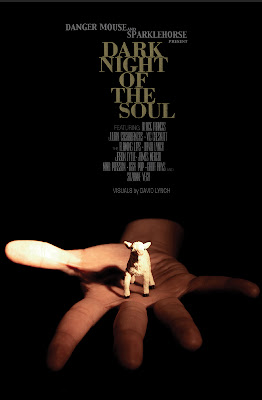
ALBUM: Dangermouse and Sparklehorse present: Dark Night of the Soul

Mentioned in bits and pieces for years, and from seeds planted as early as 2005, Dangermouse and Sparklehorse Present: Dark Night of the Soul is a wide-reaching collaboration a long time coming. Tracks crafted as early as four years ago by Dangermouse (Brian Burton) and Sparklehorse (Mark Linkous) were sent out to a slew of high profile collaborators who lent their talents, most of them appearing on several songs playing various instruments, popping up for background vocals, and aiding in production. Just a few of these names are Grandaddy's Jason Lytle, The Pixies' Frank Black, and Iggy Pop. Dangermouse, keeping up with his controlled mating of the film and music realms, includes among DNotS' laundry list of guests some guy named David Lynch (he directs movies or something?), who contributed a 100-page book of photography as a visual companion to the LP. Oh and he also wrote lyrics and sings on no less than two tracks, including the dusty, eponymous closing track. The album's completion in 2008 was followed by hazy disputes between Dangermouse and label EMI that delayed and even threatened it's release. In 2009 a hardcover, limited edition of David Lynch's photography book quickly sold out. With the music still under wraps legally, but in fact already floating around the internet, the book included a printed, but blank and recordable cd-r with a note to "use it as you will". Sadly, guest artist Vic Chestnutt passed away in December '09, followed by the suicide of Mark Linkous in May '10. July 12th saw the official release of the audio portion of Dangermouse and Sparklehorse Present: Dark Night of the Soul.

Merging Burton's cinematic production with Linkous' melancholy tone, DNotS is a detailed affair, skirting genres from grimy bar tunes to fragile pop, and generally playing in movements pulling you from one scene to another. Starting with the plodding, mournful tone of "Revenge" featuring The Flaming Lips and the pastoral twang meets bass stomp of "Just War" with Gruff Rhys, the being now known and SparkleMouse ventures far from these beginnings, planting firmly in the surf guitar jam of "Little Girl" before dropping into a slow, growling fuzz for "Angel's Harp" with Frank Black. Iggy Pop closes out the first half of DNotS with "Pain", his baritone thick among one of the more sonically raw tracks to be found here.

Computer blips and synth-tweaked vocals over a heavy pulsing bass brings us to the blissed-out "Star Eyes (I Can't Catch It)", the first sign of Lynch for everyone except the 5000 owners of the DNotS photobook, then Jason Lytle brings the grime back with "Everytime I'm With You", asking "What the hell else are we supposed to do?" in a nihilistic love-hate song about getting fucked up repeatedly. In an album wild with Dangermouse's production flourishes, "Insane Lullaby" is particularly interesting, with James Mercer's voice hovering over a bed of instruments that are largely obscured by a boiling 16th note pummel of distorted drums. Nina Persson of the Cardigans and Suzanne Vega lend the album it's most upbeat tone yet with their respective tracks, "Daddy's Gone" and "The Man Who Played God", before turning on it's heel to the morbid "Grim Augury", with Vic Chesnutt's vividly dark imagery both disturbing and engaging the listener. David Lynch shows up again for the closing track "Dark Night of the Soul", pulling the curtains on the album with an echo-drenched disappearing scrawl.

While Dark Night of the Soul has it's weak moments, even for them it's a beautiful assembly of an ambitious project, pulling together different art forms into a multi-sensory landscape, with a general clarity of vision that's surprising, given the broad range of talent involved. If this is the modern equivalent of the supergroup album, I'm in.

4 / 5